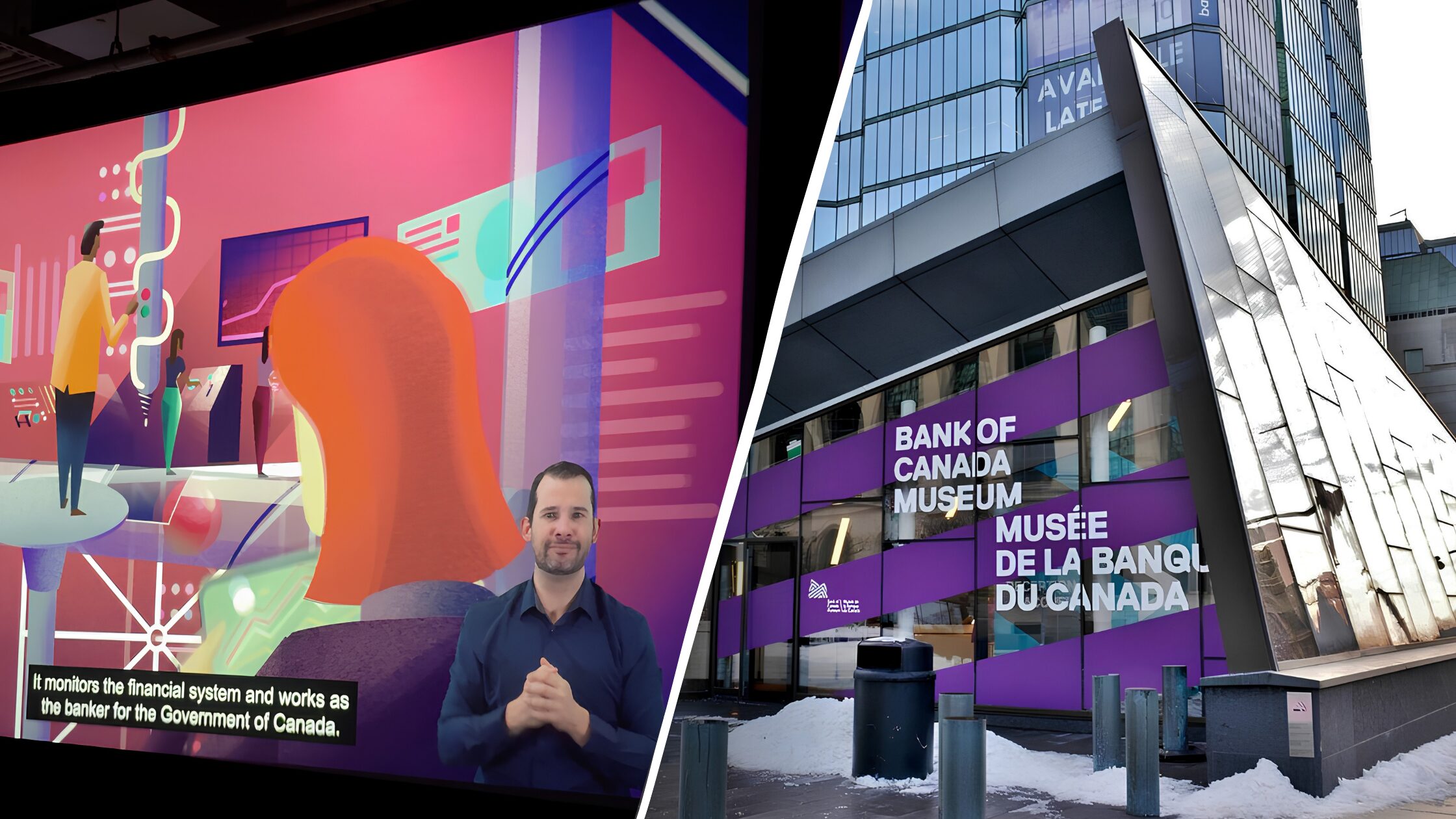
The Bank of Canada Museum aimed to make one of its core educational exhibits accessible to Deaf visitors by integrating ASL and LSQ translation into a permanent three-screen video installation.
This exhibit plays a central role in helping visitors understand how the economy functions, translating abstract financial systems into relatable, everyday experiences such as spending, saving, and major life decisions. Ensuring that this content was equally accessible to Deaf audiences was not simply a matter of adding translation. It required rethinking how accessibility could function within a visually complex, physically dynamic environment.
Asign supported the Museum to design and implement a solution that would work in real-world conditions, where attention is divided, movement is constant, & clarity is critical.
Integrating Accessibility into a Multi-Screen, High-Attention Environment
At its core, the challenge was not translation; it was integration.
The exhibit’s three-screen format was designed to create an immersive, engaging experience. However, this same design introduced complexity when layering in accessibility elements. Visitors are not stationary; they move through the space, shift their focus, and engage with content from varying distances and angles. This makes it significantly harder to ensure that all visual elements remain clear and usable.
Several key challenges emerged:
Competing focal points across three screens: The exhibit already required visitors to divide their attention. Adding translation risked increasing cognitive load rather than improving accessibility.
Simultaneous communication layers: ASL/LSQ translation and open captions needed to be visible at all times, without obstructing or distracting from the primary content.
Physical environment constraints:
- Sightlines change depending on where a visitor stands
- Viewing distance impacts readability and comprehension
- Visitor flow affects how long content is engaged with
The requirement was clear:
Accessibility needed to be intentionally designed into the experience, not retrofitted onto it.
Designing Accessibility for Real-World Use
Asign approached the project with a Deaf-led, user-centered methodology, grounded in the understanding that accessibility must be validated in the context where it will actually be used.
1. On-Site Consultation and Experience Mapping
The first step was to move beyond assumptions and understand how the exhibit functioned in practice.
Asign initiated the project with a structured kick-off session to align with the Museum team objectives, technical parameters, and accessibility expectations. This ensured that both teams were aligned not only on deliverables, but on what “effective accessibility” would look like in this context.
This was followed by a detailed review of:
- The existing video content
- The three-screen configuration
- Integration constraints within the gallery space
Crucially, Asign conducted an on-site visit with Deaf team members. This allowed direct observation of how the exhibit is experienced in real conditions, how visitors move, where they naturally focus, and what visual barriers exist.
This step shifted the project from a theoretical design exercise to a grounded, experience-based process.
Key takeaway: Accessibility decisions must be informed by how people interact with the environment, not how content is ideally structured.
2. Developing a Multi-Screen Integration Strategy
Given the complexity of the environment, a single design solution was not sufficient. Asign developed and tested multiple approaches to determine what would be most effective.
This included experimenting with:
- Translator presentation styles
Comparing transparent backgrounds versus solid backgrounds to assess visibility and integration.
- Wardrobe contrast and visibility
Testing different clothing tones to ensure the translator remained clearly visible across scenes with varying lighting and color palettes.
- Placement and scaling
Adjusting translator size and position to maintain readability without overwhelming the visual composition
Rather than making these decisions in isolation, Asign returned on-site with Deaf reviewers to evaluate these variations in real conditions. This allowed the team to assess not just visual clarity, but actual usability.
The goal was to ensure that translation remained consistently visible and understandable, without competing with or disrupting the primary narrative.
3. Visual Optimization for Clarity and Hierarchy
Once the optimal configuration was identified, the focus shifted to refining the visual system so that all elements worked together cohesively.
The final setup was intentionally designed to create a clear hierarchy of information:
- The translator was positioned in the bottom-right corner of the center screen with a transparent background, allowing for seamless integration into the content without creating visual blocks
- A navy wardrobe was selected to maintain contrast across both light and dark scenes, ensuring consistent visibility
- Captions were repositioned to the bottom center, preventing overlap with the signing space and allowing both elements to be processed independently
These decisions were not aesthetic; they were functional. Each adjustment was made to reduce cognitive load, improve readability, and support a more intuitive viewing experience.
4. ASL and LSQ Production with Message Equivalency
The content itself introduced another layer of complexity.
Explaining how the economy works involves abstract and often technical concepts. Translating this into sign language requires more than direct translation; it requires restructuring the message so it can be clearly understood visually.
Asign delivered translation in both ASL and LSQ using Deaf translators, ensuring that:
- Complex ideas were conveyed in a way that is natural and accessible in each language
- The meaning remained consistent across both ASL and LSQ
- Cultural and linguistic nuances were preserved
This process focused on message equivalency, not word-for-word translation. The goal was to ensure that Deaf viewers received the same level of clarity and understanding as hearing audiences.
5. Validation Through Community Feedback
Before finalizing the solution, Asign incorporated a validation phase to ensure the design performed as intended.
This included:
- Reviewing the implementation with the Museum team
- Testing with Deaf reviewers in real viewing conditions
- Refining placement, contrast, and visual balance based on feedback
This iterative process ensured that the final output was not just technically correct, but practically effective.
Key distinction: Compliance ensures accessibility is present. Validation ensures that it actually works.
6. Multi-Platform Delivery
While the primary focus was the in-gallery experience, the Museum also required a version of the content that could be used beyond the physical space.
Asign delivered:
- Final files optimized for the three-screen installation
- A YouTube-ready version to support digital accessibility
This extended the impact of the project, ensuring that accessible content could reach audiences both onsite and online.
A Seamless, Usable Accessibility Experience
The final implementation successfully integrated ASL, LSQ, and captions into a complex, multi-screen environment without compromising clarity or engagement.
The result was:
- A viewing experience where accessibility elements feel integrated rather than added
- Improved access for Deaf visitors in both official sign languages
- A balanced visual system that supports comprehension across different viewing conditions
Most importantly, the solution works in practice, not just in design.
From Accessibility as an Add-On to Accessibility as Design
This project highlights a broader shift in how accessibility should be approached, particularly in public and cultural institutions.
It demonstrates that:
- Accessibility must be considered at the design stage, not applied afterward
- Physical environments introduce variables that require testing and iteration
- Deaf-led approaches lead to more accurate and effective outcomes
For organizations managing complex, public-facing experiences, the implication is clear:
Accessible communication is not just about inclusion, it is about designing experiences that work for all users, in real conditions.
Asign On: Enabling Communication. Unlocking Potential.
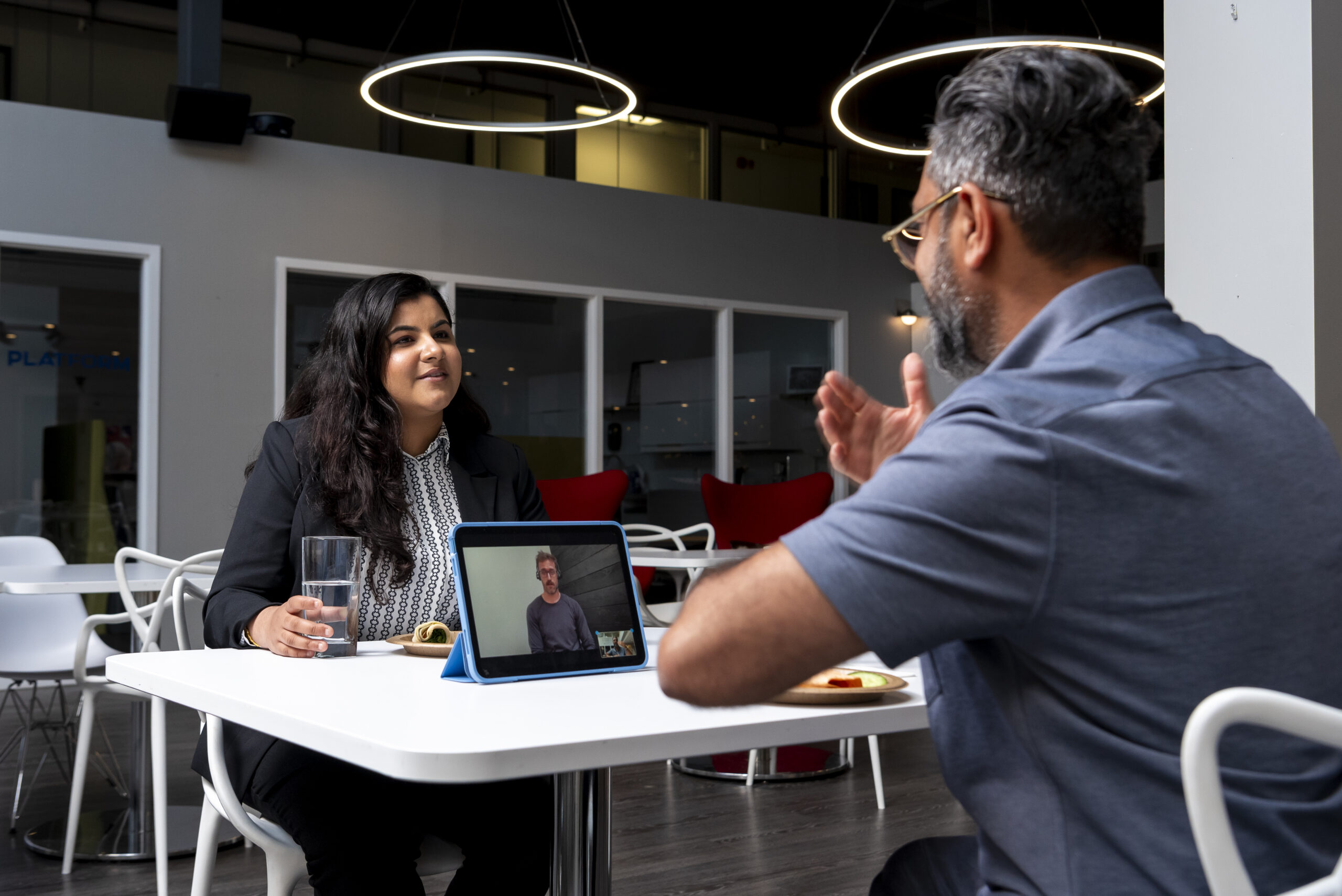
Asign’s On (VRI On-demand) connects Deaf and hard-of-hearing individuals to qualified ASL and LSQ interpreters within seconds, no scheduling required. It’s built for workplaces that value real-time collaboration, inclusion, and growth.
Discover how VRI On-Demand can transform your organization